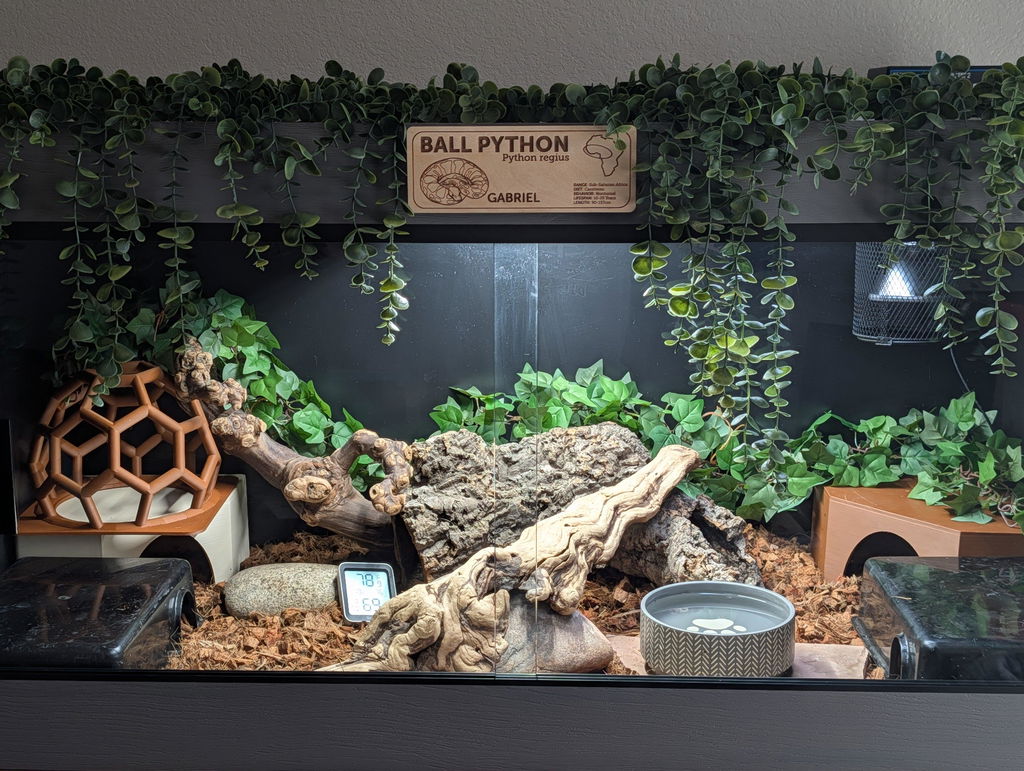
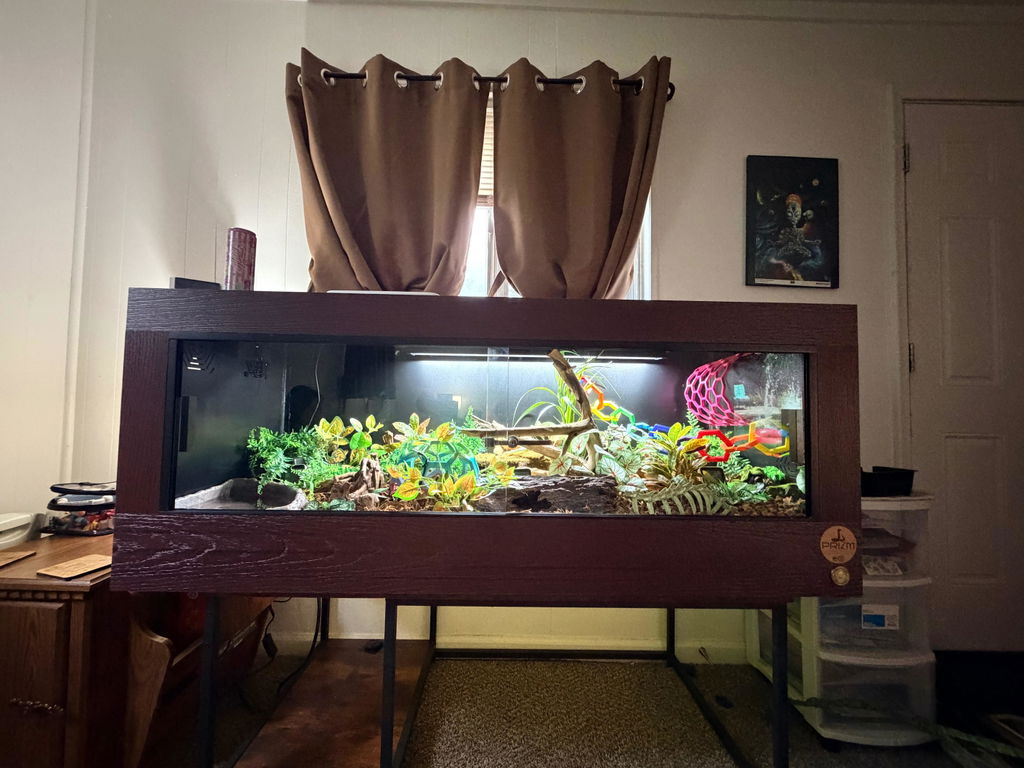
Frequently asked questions
Answers on materials, heating and lighting, living with your habitat, and ordering.
Choosing between options on a product page — sizes, frame colors, vents, windows, backgrounds — is covered separately in the options guide.
If your question isn't in either place, email sales@ToadRanchCages.com. A person will answer it.
Materials and safety
What are Toad Ranch habitats made of?
Premium Components. Uncompromising Quality. Luxury is standard at Toad Ranch! Along with premium components and superior design, we include the little things that matter. Every habitat is built from the same core set of components:
- 1/4" certified tempered glass doors, all edges polished
- 3/4" solid HDPE front frame
- 1/2" PVC body panels — left, right, top, bottom, and back
- Tortoise shell vents, which accept either a cover or a fan
- Stainless steel interlocking stacking dowels
- Screw covers, so no screw heads are visible
- 100% USA-made plastics
Designed and fabricated in Webb City, Missouri. Veteran owned.
Is the front frame painted or stained?
No. There are no paint or stain fumes here. Our signature front frame isn't just for show; it's the backbone of our design.
The frame is 3/4" thick high-density polyethylene — the same rigid plastic used in marina architecture, boat building, outdoor resort cabinetry, and playground equipment. It is UV stabilized and colored all the way through, which is why it won't fade, chip, rot, swell, delaminate, or scratch off. The color isn't a layer on top of the material; it is the material.
What are the body panels made of?
Standard body panels are 1/2" PVC — we exclusively use premium, top-grade material engineered with an optimal density. This delivers the perfect balance of lightweight design, exceptional rigidity, and outstanding performance — including superior screw-holding strength for secure assembly and long-term durability. Available in white or black, same color and smooth texture on both faces.
If you'd prefer the look of the front frame rather than black or white, the Executive Upgrade swaps the side panels to 3/4" solid HDPE. The options guide covers what that changes.
Are the materials safe for my animal?
Made in the USA, and specified so you don't have to wonder what's in them.
The 3/4" HDPE front frame is CPSIA compliant — the same federal lead and phthalate standard written for children's products — along with RoHS and REACH.
The 1/2" PVC body panels are RoHS and REACH compliant, free of lead, cadmium, barium, and zinc, and non-hazardous under OSHA. At the 12mm gauge we build with, the manufacturer's data sheet also reports that no California Prop 65 warning is required, and rates the panels UL 94 V-0 for vertical burn and ASTM E84 Class A for flame spread — worth knowing in an enclosure that holds heat lamps.
These materials also won't rot, swell, delaminate, or fall apart under the humidity and heat reptiles need — the failure modes wood eventually has in a warm, wet enclosure.
Are Toad Ranch habitats bioactive safe?
Yes. They were designed with bioactive setups in mind, and the plastics don't off-gas or break down the way wood does.
Are they stackable?
Yes — Habitats stack on stands, canopy hoods stack on habitats, and habitats stack on each other.
The one thing we'd steer you away from is stacking two of our largest habitats directly on top of each other — like our 8x4x4 on an 8x4x4. A stand underneath or a canopy hood on top is a different matter and works at any size.
The front opening is the most vulnerable point on any PVC enclosure — front sag is what causes sticking doors over time. The signature front frame exists to solve that, and it produces one of the most structurally sound front openings available in a PVC habitat.
Every habitat, stand, and hood ships with our interlocking stacking dowel system, so you can mix and match sizes when stacking and still get a nearly seamless stack. No spacers or stackers required.
If you're ordering a large custom size and plan to stack, tell us — we can add extra support.
Sizes and dimensions
How are dimensions measured?
All habitats, stands, and hoods are listed as length x width x height, and those are true-to-size exterior dimensions.
A 48x24x24 habitat measures exactly that on the outside — not 47", not 23.5". The exterior number is the one that matters when you're fitting a habitat into a room, onto a stand, or under a shelf, so that's the number we publish.
Length runs side to side, width runs front to back, height runs top to bottom.
To find interior dimensions, subtract:
- 1" from the length (1 1/2" with the Executive Upgrade)
- 1 1/4" from the width
- 1" from the height
What if the size I need isn't listed?
Sizes outside the catalogue are built as custom orders. Review the options guide first, then submit a custom quote request with as much detail as you can give — species, room, heating plan, and any dimensional constraints. We'll send a personalized quote to review before anything is built.
Heating and lighting
What we do and don't supply?
Heating and lighting are sold separately and we don't install them. Every habitat ships ready for you to fit your own fixtures, and what follows is guidance on doing that well — the equipment choice and the installation are yours.
How do I mount heating and lighting in a solid-top habitat?
With interior-mounted heat light fixtures — and the thing to look for is a holder that stands off the ceiling panel rather than sitting flush against it. The lamp body should be suspended in its bracket with an air gap behind it.
That gap does real work. PVC softens at 168°F, and the air gap is what keeps heat from conducting straight into the panel at the mounting point. A fixture that sits flush concentrates heat exactly where you least want it.
We use the Arcadia Lamp Holder Pro in our own habitats and stock it as an accessory. Anything similar works, as long as it holds the lamp clear of the panel. The bracket screws straight to the ceiling panel with 1/2" screws — no pre-drilling, a screwdriver and your hands are enough. Arcadia UVB and LED fixtures mount the same way, with two brackets and two screws.
Mounting tip.
Lay the top panel on a smooth, flat surface. Position the fixture, mark the mounting points in pencil, then drive the screws.
Check your orientation before committing. The front edge of the top panel carries the dowel holes. With the panel in front of you and the dowel holes closest to you, the side on your right becomes the left side of the habitat once installed.
If your habitat has ceiling beams, light bar mounting blocks are available on our Lighting page. These hold LED and UVB fixtures off the ceiling panel to clear an aluminum support beam.
What are the heating safety rules?
Care should be taken with any heating device in any enclosure material, PVC included.
Placement
- Do not mount heat lamp fixtures above Cliff Hanger climbing shelves. Radiant heat panels above them are fine.
- Keep heat fixtures at least 6" from any side or back panel.
Solid tops
If you keep a snake, or any reptile that can reach the fixture, use a wire heat lamp safety basket over the bulb. This prevents burns and keeps the animal off the heat source.
Screen tops with clamp lights
Clamp lights get knocked loose. Drill a small hole in the rim of the fixture and secure it to the screen with a wire tie.
Ceramic heat emitters
We don't recommend CHEs inside PVC habitats. Their surface temperatures run hot enough to damage the enclosure and pose a burn risk. The Arcadia Deep Heat Projector delivers comparable infrared heat without the surface temperature.
Thermostats
Use one with every heating device, without exception.
Why do you recommend Spyder Robotics thermostats?
Basic thermostats can fail in the "on" position, which is how runaway heating happens. Herpstat units are built to fail safe instead:
- A mechanical safety relay cuts power to all outputs if the main control fails or a user-set error condition is met
- Internal error detection shuts off heat if the temperature probe fails or disconnects
- High and low temperature alarms, which can be set to trigger the safety relay
- Internal overheat protection monitoring the thermostat itself
- User-replaceable fuses, per output on multi-zone models
How do I set up my lights?
Reptiles thermoregulate by moving between warm and cool areas, so the goal is a gradient — a basking zone at one end, a cool retreat at the other.
In the wild, heat, visible light, and UV all arrive from the same direction. Grouping your sources over the basking zone reproduces that, and lets your animal move in and out of the warm area deliberately.
- Mount two heat fixtures, each with a safety basket, side by side near the center of the basking area, roughly 6–8" apart.
- Position the UVB and LED fixtures in front of or behind the heat fixtures.
- Aim all of it over the basking platform.
Species-specific recommendations are in the Lighting Guide.
How do I create a temperature gradient?
- Always use a thermostat. This one isn't optional.
- Group heat and light over the basking area, and leave the far end alone.
- Use lower wattage bulbs than you would in a glass tank. PVC holds heat, so the same bulb runs hotter here.
- Give your animal a real basking platform — natural stone works, as do our Bask-N-Hides.
What wattage bulbs do I need?
There's no single answer. Wattage depends on your room's ambient temperature, the size of the habitat, the distance from bulb to basking platform, and the range your species needs.
Two lower-wattage bulbs generally beat one high-wattage bulb — heat spreads more evenly and you get finer control.
Does my reptile need UVB?
For the large majority of species, yes. UVB drives Vitamin D3 synthesis, which governs calcium absorption, bone health, and immune function. Its absence is the primary cause of metabolic bone disease.
Do heat mats work through PVC?
Yes. Run one on a thermostat and double check surface temperature with a temp gun. PVC softens at 168°F.
If you're planning to use a heat mat, add a temp probe channel when you order — it's a 1/4" channel cut into the underside of the bottom panel so the probe can sit beneath the mat.
Airflow and humidity
Do I need a fan?
Not every habitat needs one, but fans are worth adding for bioactive builds, high-humidity species, and any setup where you're fighting stagnant air or excess moisture.
What a fan does:
- Moves 51 CFM, enough for a complete air exchange in a short time
- Stimulates airflow, which mimics changing weather and provides enrichment
- Reduces excess humidity and lowers the risk of mold
- Helps manage ambient temperature when the room is too warm to hold a proper basking gradient
Fans mount over any Adaptive Vent (tortoise shell vent) with no cutting, and bolts and nuts are included. Run yours on a timer for short bursts several times a day, or on a thermostat with a temperature or humidity probe if you want it responding to conditions rather than the clock.
Can I change my ventilation after my habitat arrives?
Yes, and this is deliberate. Every Adaptive Vent (tortoise shell vent) uses one mounting interface that takes either a fan or a pop-in cover, so any vent can be opened, sealed completely, or powered — and changed again later.
Covers and fans are stocked accessories, not build-time decisions. New species, a new season, or moving a habitat to a different room can all change what a setup needs from its airflow, and none of those require a new enclosure.
Insert-style vents can also be unscrewed and flipped if you want the finished face on the other side, but are not compatible with fans and vent covers without further design.
My humidity is too high. What can I do?
Before buying anything, check two things: make sure your substrate went in dry, and make sure your water bowl isn't sitting over a heat mat or directly under a heat lamp. Those two account for most humidity complaints.
If it's still high, a fan over one of your vents is the reliable fix — and it stimulates activity in most species as a side benefit.
Doors
What are the doors made of?
Sliding doors of 1/4" certified tempered safety glass, every edge polished. Our glass is sourced locally here in Missouri, and each pane carries an etched tempered stamp.
Each pane is permanently etched with its certification: ANSI Z97.1-2009 and CPSC 16 CFR 1201 Category II.
Category II is the higher of the two federal impact ratings — a 100 lb bag dropped from 48 inches, against 18 inches for Category I. It's the level required for sliding patio doors and shower enclosures. Our door panes are small enough that the lower rating would satisfy the code, and we use Category II glass anyway.
Tempered glass is four times stronger than standard glass, and holds several advantages over plastic glazing:
- Won't yellow, cloud, warp, or bow over time
- Highly scratch resistant
- Genuinely clear viewing
- Cleans with ordinary glass cleaner, which matters for a chore you'll do constantly
For institutions: fixed tempered glass fronts with a swing HDPE access door are available for zoos, nature centers, and professional facilities.
Are the glass doors removable?
Yes. A slight lift-and-tilt motion takes them out, which makes deep cleaning straightforward.
What do the doors slide on?
A dedicated track, not a channel cut into the frame.
Most PVC enclosures route the door channel straight into the front frame material, so the glass runs against the boards itself. We fit a separate track on top of the frame instead. Two things come from that: the glass slides on a surface built for sliding, so the action stays smooth, and because the track sits above the frame rather than being sunk into it, substrate can't pack down into the channel and bind the doors.
We also run track down the sides of the front opening. That's partly appearance — the glass is seated on every side rather than ending at a raw edge — and partly security. A seated edge gives nothing to hook a finger or a toe behind and lever open.
Do I need a lock?
It depends on your species, but we'd recommend one in most situations.
Many smaller lizards and some snakes can't open the sliding doors, so a lock isn't always needed to prevent escape. We still use locks on our own habitats for two reasons: it's a reliable prompt to confirm the doors are fully closed after feeding or maintenance, and it keeps curious children and other pets out.
Living with your habitat
Is assembly difficult?
No. A screwdriver is the only tool required, but an electric screwdriver will get the job completed quicker.
The front frame arrives pre-assembled with the glass door track installed, leaving five body panels to fasten to the frame. Every screw in the build is the same size, and every habitat, stand, and hood is fully assembled in the shop before shipping to guarantee the fit — so nothing needs forcing on your end.
Written assembly instructions and setup videos are linked in the Learn More menu.
Why isn’t my enclosure top panel lining up correctly?
Every Toad Ranch enclosure is precision CNC-cut and fully pre-assembled in our shop before it ships. That dry-fit is how we confirm the panels, screw holes, and front frame line up cleanly — so the parts you receive are already proven to fit.
If the top looks off during your build, it is almost always one of two things:
1. The enclosure is being assembled on an uneven surface. Carpet, a warped workbench, or a floor that isn’t level will throw the box out of square as you add panels. Build on a flat, rigid surface (a level table, garage floor, or sheet of plywood works well). Level the habitat once it is together as well — that also keeps stacked units looking tight.
2. The already-assembled panels just need a small adjustment. The body is already together; it may only need a slight nudge so the top holes line up. Seat the top with the label facing in and the arrow toward the front, then fasten. Do not force screws. If a hole is shy, ease the panel rather than driving the screw at an angle.
A few extra habits that help:
- Confirm every panel arrow points the correct direction (front on the sides/top/bottom; up on the back).
- Seat cords in the back-panel grooves *before* you fasten the top.
- Start every screw, then snug them in sequence once the top sits flush. An electric driver is fine — keep the clutch low so you do not strip or overtighten.
- If you are stacking, level each unit before dropping in the dowels.
The fit is already there. A level surface and a small panel tweak almost always bring the top into perfect alignment. Written instructions and videos are in the Learn More menu if you want a visual walkthrough. If it still will not seat after those steps, send us a photo and we will walk through it with you.
Will my habitat leak?
The joints are tight, and under normal husbandry conditions these habitats don't leak. A tipped water bowl or standing water can find a seam, though.
Sealing the lower seams is a simple precaution and we'd recommend it. Lexel and DAP 230 are both trusted in the reptile community — we've used Lexel for years across a wide range of species, including sensitive ones. Standard silicone doesn't adhere well to PVC or HDPE and isn't a good choice here.
Can I add casters?
We don't recommend mounting casters directly to the bottom panel. A caster stand supports the full panel and is built for the load — 5" tall, 3/4" HDPE, designed specifically for caster mounting without sagging.
How do I install a Destinations background myself?
Backgrounds ordered with a made-to-order habitat are installed for you. If you bought one separately, or with a Quick Ship habitat, it's a straightforward install:
- Lay the panel on a clean, flat surface.
- Position the background and hold it with painter's tape.
- Apply with application fluid and a squeegee.
- Cut openings for vents, slots, or grommets with a sharp X-Acto knife.
Backgrounds can't be mounted directly to HDPE panels.
How do I clean the glass?
For routine cleaning, any reptile-safe glass cleaner, or water with a few drops of dish soap.
For hard water spots, wipe with vinegar and water. For spots that won't lift, #0000 super-fine steel wool used gently in a circular motion will clear them without scratching tempered glass.
How do I clean the rest of the habitat?
Vinegar and water, or any non-abrasive reptile-safe cleaner, works on PVC and HDPE inside and out. Spot test anything new somewhere inconspicuous first.
Keep habitats indoors or in shade — PVC can warp in direct outdoor sun.
Ordering and shipping
Why is the lead time what it is?
Every habitat is made to order. Nothing sits on a shelf waiting to be boxed, and each one moves through the same production process, built to the standard you'd expect from custom furniture.
Lead times shift with order volume and are posted on the site as they change.
How do I order a custom size?
- Review the options guide.
- Submit a custom quote request with as much detail as possible.
- Review your personalized quote.
- Complete your order.
How much is shipping?
Free on all habitats, stands, and hoods within the contiguous United States.
Alaska, Hawaii, and some remote or hard-to-reach addresses fall outside that and may carry a freight charge. These are large items and the cost varies a lot by destination, so email us with your address before you order and we'll get you a quote.
Heating and lighting items ship separately and are calculated at checkout.
Can I track my build?
Not automatically. Because each habitat is built to order rather than pulled from stock, there's no live tracking feed to point you at.
Email sales@ToadRanchCages.com any time and we'll give you the current estimated ship date.
What if my habitat arrives damaged?
Damage is rare — packaging is thorough and every shipment is fully insured — but if it happens, email us within 7 days of delivery.
Send clear photos of the damage, the box, and the packing material. Those photos are what let us move quickly on a claim.
What if parts are missing, or the order doesn't match what I selected?
Contact us as soon as you notice. We'll verify the order details against your build and send replacement parts as quickly as we can.